BUBO Listing www.bubo.org

Thursday, 17 February 2011

January Highlights....

It was a busy start to the year with some interesting birds to add to our list. On the 1st of January we headed to the North Norfolk coast to visit Titchwell and Cley. At Titchwell we had great views of Bearded Tit and Water Pipit from the new Parrinder Hide.
At Cley we caught up with the Ross's Goose which was associating with a group of Barnacle Geese on Arnold's Marsh.


The following week on the 9th January we travelled to Strumpshaw, Cantley and Hickling to see what was around. We started off at Whitlingham Country Park where Red-breasted Goose had been reported but were unable to locate it. At Strumpshaw we had Water Pipit, Stonechat and Marsh Tit. We were put onto the Lesser White-fronted Goose at Cantley by one of the enthusiastic birders already at the site, which meant that we didn't have to stand and freeze for too long. Unfortunately the bird was too distant for photographs.
We timed our arrival at Hickling so that we could get to Stubbs Mill for the Harrier Roost. Good numbers of Marsh Harrier, male and ringtail Hen Harrier, Sparrowhawk, Merlin, Barn Owl, Common Crane and Pink-foot Geese showed well in the late afternoon sun. This Kingfisher was oblivious to it's audience as it scanned the stream for it's supper.
Kingfisher at Stubbs Mill
 Leaving the watchpoint just before dark we arrived back at the car park in time to see Woodcock flying over in every direction - a fantastic end to the day.
The following week we were in North Norfolk hoping to catch up with the Northern Harrier and Rough-legged Buzzard - unfortunately we dipped! We did manage to get good views of the American Wigeon at Cley although visibility was not brilliant.
 
On the 30th January we visited Abberton Reservoir and Tollesbury Marshes with the Beds Birds group. We found 3 drake and 6 red-head Smew altogether. The males displaying at times. Also distant views of a ringtail hunting.


From the bank at Tollesbury Marshes we watched a Great Northern Diver and a Slavonian Grebe on the River Blackwater.

Monday, 13 December 2010

Monday, 29 November 2010

Wonderful Woburn Waxwings

We decided to see if we could catch up with the Woburn Waxwings yesterday morning and left home with -4.5 degrees on the thermometer. We arrived in Leighton Street in time to see them flying to and fro across the street and settling from time to time in a bare tree at the back of the garden next to number 10. We had great views of up to 18 individuals and watched them feeding and passing berries to each other. What lovely birds!

Zero degrees + ice + fog!

We must have been mad! Well, maybe just a little. With visibility a very murky 250 metres Gen and ourselves visited Elmley Marshes yesterday in the hope of seeing Short-eared Owl and maybe one or two of the more elusive raptors. Marsh Harrier,Common Buzzard and Kestrel were the only ones seen plus a few waders - Dunlin, Ringed Plover, Grey Plover, Redshank, Blackwit and Curlew which we peered at through the mist.
Kestrel at Elmley Marsh

After lunch we decided that a drop-in to Rainham Marshes might be more productive.  Short-eared Owl had been seen very early in the morning and not since but there were several Bearded Tits showing well in the reed beds by the side gate. We were in luck, they were still feeding avidly on the seed heads and showed well in the late afternoon sun. A good way to end a very unpromising day!
Bearded Tits at Rainham


Friday, 19 November 2010

An Owl of a weekend!

On Saturday we (that is Gen and ourselves) travelled to Gloucestershire via the Cotswold Water Park near Cirencester. Reports of a Short-eared Owl had been posted during the week and we thought it might still be around. A short walk from the car took us towards the Shorncote Reed Bed, luckily we met another birder whose first words were "Have you seen it?". He had just been watching it and it had flown in our direction! And there it was - quartering the field to our right. It was a beautifully coloured bird and seemed not to be too bothered by an audience. We watched it for over half an hour as it hunted, perched and then hunted again.
We travelled further on to Frampton-on-Severn in the hope of seeing Water Pipit but lacking local knowledge and details of location gave up and moved on to check what birds were around at Slimbridge before driving down to Ham Wall in Somerset for the Starling roost. WOW!! Along with a hundred or so people we watched and listened to over 50,000 starlings gathering at Ham Wall to roost in the reed beds. Passing Sparrowhawk and Marsh Harrier only helped to enhance the spectacular show. The sight and sound was unforgettable and made more so because they were reasonably close to where we stood.  
On Sunday we met up with other Beds Bird Club members for a visit to Slimbridge. A very murky start meant a tour round the pens and ponds admiring the very colourful waterbirds. A visit to the Holden Hide when the fog had lifted revealed Canada, Barnacle, White-front, Pink-foot and Greylag geese, a couple of Buzzards, a Peregrine, Curlew, Lapwing and Dunlin plus a few Shoveler, Pintail, Mallard etc. We finished with a visit to the Wild Bird feed which only had a few Bewick's Swans and no Whoopers.

Caribbean Flamingos
White-faced Whistling Duck
Ringed Teal

Monday, 8 November 2010

Suffolk highlights!

On Saturday we made our way to the Suffolk coast in the hope of catching up with the King Eider that has been around for a while. On arriving at Minsmere visitor centre we were told that it has been moving between Dunwich and Sizewell and it was anyone's guess where it might be, another comment was that it had been seen most regularly offshore from Minsmere reserve at about 2.30pm! Undaunted we set off towards the beach for a sea watch. Malcolm had soon got his sights on the King Eider which was drifting steadily north/south towards Sizewell. At first we had quite poor views of a dark bird bobbing up and down between the waves. Luckily it was disturbed by a fishing boat and flew back towards Dunwich and coming closer in to the shore. We were able to see it more clearly, it's colouring and markings being quite distinct. It seemed to be very settled, fishing and preening in front of a growing audience of birdwatchers.

 A quick visit to the East Hide revealed a flock of about 15 Waxwings flitting among the trees behind the North Hide so we hurriedly retraced our steps to try and get a better view. Eventually we found a single waxwing in one of the trees near the visitor centre and managed a couple of photos before it flew off.
A message on Birdguides confirmed the continued prescence of a Richard's Pipit at Covehithe so we went to see if we could find a second 'lifer' for the day (got to keep our averages up!) As luck would have it we were able to follow some fellow enthusiasts and had good views of a very mobile bird.

We finished the day by walking to Island Mere Hide to see if we could find anything else of interest. We were rewarded by cracking views of a ring-tail Hen Harrier which flew in front of the hide with the setting sun behind it. Altogether a great day's birding.

Friday, 29 October 2010

Another Algarvian Adventure

Azure-winged Magpie 
On October 1st we flew to Faro with our friends Gen, John and Pete. Our holiday cottage overlooked the Ria da Formosa saltmarsh and lagoons with a good variety of waders and sea birds.


The garden is a haven for local birds including Azure-winged Magpie, Little Owls, Spotted and Pied Flycatchers, Great Spotted and Iberian Green Woodpeckers, Waxbill,  Hoopoe, and Red-rumped Swallows to name but a few.

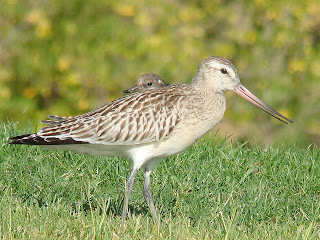
Bar-tailed Godwit 


Griffon Vultures 


We managed to fit in a Pelagic from Sagres for Shearwater and a visit to the Alentejo for Bustards, Vultures etc. as well as visiting the Odiel Marshes in Spain and the Castro Marim salt pans.


Red Signal Crayfish at Vilamoura
Monarch Butterfly at Vilamoura  


Other sites that we visited included Quinta do Lago and Ludo Farm, the Parque Ambiental at Vilamoura and Lagoa do Salgados.


Our final species count was 156 which included a Sacred Ibis found at Salgados on the last day. A tropical downpour was a refreshing end to a great birding holiday!